Oz Working Dogs - Assistance & Working Dog Equipment

For assistance/service dog equipment, as well as guide, therapy, detection, search & rescue, police and dogs in training equipment check out my website http://www.ozworkingdogs.com.au - I make and sell vests, capes, belly bands, harnesses, handles and more... and will post to the world!
Showing posts with label retrieve. Show all posts

Monday, May 28, 2012

Knightley 10 months old, new sleeping arrangements, hip injections and deposit on car!

10 months old

Well I usually get photos on the day of every month birthday, but today was just a bit too busy! I'll try to get some tomorrow. It seems sooo short between each month birthday, it seems only a week or at the most two since I was saying he was 9 months old. He neeeeeeearly lifted a leg when peeing against a tree today. My boy really is growing up. He also has new sleeping arrangements as of tonight. For the first couple of months of his life with us he slept closed in his crate, then after that we graduated to sleeping in a rather large pen (because he liked chewing things and destroying things a little too much... just loves things in his mouth - still does), and then today graduated to having the kitchen and dog/dining area to himself every night. It's extremely neat tonight, which is certainly important for the first night so he doesn't get into something on the first night and get into a habit after that. The main reason it's perfect in its neatness, and the reason I decided to make the change now, is that we have a rental inspection tomorrow (usually every 6 months, but it will be 9.5 months this time) and I wanted to put away the pen. When I went to check on Knightley after finishing cleaning the bathrooms to a soft gleam (! or trying, as far as rental houses can be pushed towards gleaming!) he was lying virtually in the middle of the floor, but I kind of expect him to be in his crate when we come out in the morning.... that is usually where he is in the morning.

It's just totally amazing how fast he has grown up. People who meet him when we are doing our public access training no longer recognise him as a puppy, although they often realise he is on the young side. When I tell them he is nearly 10 months old they are amazed how big he is (I don't really think he is big! compared to some other breeds he is rather medium sized!) and how well behaved he is for a puppy. If only they could see him when he grabs some contraband!! Still, he is a darling pup. Only two more months and we'll be getting hip x-rays which will tell us his future with me and whether he can truly be a working assistance dog. Unfortunately Golden Retrievers have quite bad hips, and while I am doing what I can to end up with good hips on Knightley, you can never know.

Anyway, today I had a couple of injections into my 'bad' hip, my right hip. Last time I had this done I was virtually immobile for a week.... I woke up the day after the injections and could barely move my leg. The injections were painful today, and they also did a nerve block for the first time, so we'll see what happens there.... but if they help this time, it'll be worth it. I expected to barely be able to clean the house tonight because of my hip but it has been ok, as long as I don't stay still for too long because then I start to seize up. It could be very bad tomorrow. I got a call from the place I work/volunteer and they are begging me to come in tomorrow as there has been a crisis and we have an important event coming up on the weekend. Rather stupidly I said yes, so I am quite sure I will need a wheelchair. It isn't going to be a very wheelchair friendly office, but I'll cope. I find it very hard to say no when people actually *want* me. It is something I have to work on - saying no for the sake of my health.

In case your missed the photo in my last blog post, our new
car! Plenty of room for dog face (my loving name for Knightley!)
in the wagon part. The car is in good nick although I would have
rathered a few less kms on the clock, but we don't expect it to last
forever - just until my hubby gets some well deserved raises at
work over the next couple of years! The car is exactly what we
wanted though. Definitely want to take it on a weekend away!
After the hip injections hubby and I and my parents went to the other side of town to check out the car we were interested in again (a used car, see previous post for details). To cut a long story short, we have put a deposit on it, and are buying it!!! It's 'our' first car, and has plenty of room for passengers, and Knightley too as it's a stationwagon. It's fitted out for a roof-rack as well, so we may look into that too for flexibility. Anyway, it has a few easily fixed minor issues, so we will be picking it up on Thursday arvo (Monday night now) when everything is fixed. The only problem is because it's a stationwagon, to go in the wagon part Knightley will have to really jump and he is *SOOO* bad at jumping lol. He can't jump into the back seat of a normal sedan - he sort of pulls himself up. I know it's partly a puppy thing... but hopefully he will learn to jump soon. He actually can jump quite well when he wants to, so we just have to harness that. Maybe big chunks of beef heart (his favourite) in the back after fasting him for a day!

Speaking of fasting for a day.... I mentioned in my last post that Knightley had had a bad tummy. I decided to fast him for a day to let his stomach settle down. It's always a good move to make, it means that any last diarrhea can make its way out and it also means you won't irritate the stomach again before it's ready. Bone if good to stop the runs, so I wanted to feed chicken+bone with large percentages of bone tonight, but the silly hubby forgot to get the chicken wings I asked him to, and we have no chicken in the freezer. He did however get a nice cheap pork leg roast - so Knightley got a smallish serving of that with the leg bones. Leg bones of the larger ruminants - cow, deer etc are not safe to raw feed as they can break your dogs teeth. However, small animals like rabbit and chicken are absolutely fine, and so is everything up to pig and sheep. Try to cut down on fat when your dog's stomach is upset too, just feed chicken or turkey. If you can't feed those, pork is the next best choice. My poor boy was obviously very hungry, and like usual it was great to see him happily gnawing and crunching away, but we'll see how his stomach is tomorrow.

Anyway, tomorrow I need to get up early to do some finishes to the house, so it's sleep time for me. Cross fingers for me that I can actually walk! Wish I could take Knightley to the office already for his retrieve, dropping things in a wheelchair is going to the awkward as I'm usually with a family member when I'm in the chair......

Monday, April 30, 2012

Picking a puppy from a litter for assistance/service or therapy work

8 months 2 days old

Updated 13th June 2013

This is the third post in a series where I answer some of the common search queries I receive. I speak only reflecting my own experience, in this case temperament testing three litters - two to find Knightley and only one to find Apollo.

While this temperament test is intended for assistance/service puppy prospects, it would work perfectly well for testing a pet, a therapy dog, or a different type of working dog. You certainly wouldn't need to do all the parts of the tests if you were just looking for a pet, and I would only look for a puppy who scored at about the middle of the range - having a super smart dog as a pet can get you into trouble! Feel free to ask questions about adapting the test for pets or other working dogs.

Please note: This test can be used on adult dogs with a few small changes. You may have to skip the first test if the dog is large, you shouldn't clap for the recall test as adult dogs shouldn't need to be attracted like that, the food drive test is even more important as it also tests mouth inhibition (does the adult dog know not to use its teeth on your flesh?), and you'd have to do the webbing test with larger dogs on the ground. Often older dogs are quite touchy with their feet, but it may help to get down on the ground with them. Whether or not they are touchy with their feet shows how much work the previous owner has put into physical desensitisation and grooming.

You may also wish to add to the test a couple of commands - just to place the obedience/training level of the dog. Sit and down would be appropriate, and you could also test how the dog walks on a lead. When choosing an adult dog, having one that has had at least a little training bodes well for its other history.

_______________________________________________________________

It was about three and half years ago I became interested in the idea of an assistance dog (we call service dogs assistance dogs here in Australia), but it took me much longer to research the practicalities of whether it would be feasible for me to have one. I eventually decided I would self train, but then it once again took me a long time to find a breeder, and then a litter and puppy I was happy with. Unfortunately Knightley (my first dog) was found to have severe hip dysplasia, so I had to go through the process all over again to find my second dog, Apollo.

Knightley, happy to lie at my feet and play with toys and get
lots of attention on the day we tested him when he was
7 weeks old. He did extremely well on the temperament test
that day, and the test has been borne out in his behaviour
since.
My experience that was finding the right breeder was important for finding the right puppy. You don't really want a breeder who is themselves quite timid and rarely goes anywhere, who mostly keeps to themselves on their property, as it seems from my experience that they can pass it onto their puppies. Find a breeder who has the puppies inside at least some of the time so from a young age they can get used to different surfaces. Also, it is important that they have people over to socialise with the pups, preferably children and men as even fully trained assistance dogs can be challenged interacting with them. Find a breeder who is likely to produce confident puppies so that you won't waste a trip going to see a timid litter

I have put together my own temperament test, which is a bit of a mixture of the Volhard test (which I see as quite outdated), the PAWS Working dog test and of my own devising, and all given a specific slant for public access work, which I've rather immodestly labeled as the DAD temperament test (downunder assistance dog). I ran it all past some very experienced assistance dog trainers who thought it was right on the mark, and I used it to select both my boys, who have both turned out to have wonderful temperaments, perfectly conjusive to acting as a working dog. You can read about my experience with the first litter I tested here, three puppies all of which I rejected. I wanted a male, and apparently *one* of the females in the litter had a confident, outgoing temperament, but that was not a good outcome for a litter of 6. They were extremely timid pups compared with the second litter of 11 puppies I looked at, 8 of which were male. The final litter I tested (from which Apollo came) was even more outgoing. The breeders put a lot of effort into raising those puppies and it really showed in the temperament test. Apollo was kept with his litter and mother until he was nearly 10 weeks old, and this turned out to be a very good thing. He learnt excellent bite inhibition and didn't ever nip us as a puppy, and learnt to get on with the other adult dogs the breeder owned. However, if the breeder isn't particularly proactive in their socialisation of the litter, it may be worth still bringing the pup home at 8 weeks so you can start the socialisation process. In Apollo's case he was better off remaining with the breeder for an extra couple of weeks.

Knightley doing the retrieve test with the breeder (after I had
done it too), very nicely I might add!
Anyway, here is the temperament test I used. I found sometimes you didn't need to go further than the second or third test with some puppies, because it was completely obvious that the puppy was unsuitable. A very experienced trainer once told me that the purpose of temperament testing was really to discount the puppies you didn't want, rather than the puppies you wanted. I found it quickly became very obvious when a puppy wasn't suitable. Deciding if a puppy was quite good enough is then up to you really, and that's where the scoring can come in handy, especially when comparing two puppies.

If possible do this test when the puppy is 7 weeks old, and get the puppy when it is wide awake as it will give a better performance. Try not to tire it out - if you are keen on it and want to do all the tests you may need to come back on another day. Little puppies need lots of rest!Taking a helper with you is recommended. You will want to prepare a temperament testing kit (see what to take further down the page).

DAD (Downunder Assistance Dog) Temperament Test

1. Lap Test

Lift the puppy onto your lap and simply stroke it. Note its posture and other body language carefully. Does it relax confidently on your lap and enjoy the stroking? Or does it crouch nervously and just shiver? This tests sociability. It is particularly important for Psych Assistance Dogs and therapy dogs.

Great ----- Relaxes on your lap, gives eye contact, curious OR climbs up towards your face to investigate and solicit attention 3 points
Good ----- Relaxes on your lap 2 points 
OK -------- Stands on your lap, loose and unafraid 1 point
Poor ------ Crouches on your lap, may tremble OR struggles to get down 0 points

2. At foot Test

Lift the puppy down to floor level at your feet. Make sure you are in a secure room or in a puppy pen for this one. Continue to pat the puppy as it is by your feet. Once again, watch its body language carefully. This tests sociability, independence and confidence. Once again this test is particularly important for Psych Assistance Dogs and Therapy dogs.

Great ----- Stays by your feet, enjoys the interaction, body loose 3 points
Good ----- Stays by your feet for a while, explores but comes back 2 points
OK -------- Stays briefly, off to explore showing independence 1 point
Poor ------ Moves away from you and cowers in a corner OR stays cowering against you, doesn't enjoy the stroking, body tight, possibly shivering 0 points

3. Recall/Come Test

Get your assistant to move the pup two or three metres (6 to 10 feet) away from you and call it to you - if the breeder is with you, ask what they use to call them for food time. You can clap or do anything else to help get the pup to you.

Great ----- Comes to you with little hesitation 3 points
Good ----- Takes a lot of encouragement, but comes 2 points
OK ------- Watches you, starts towards you, doesn't come whole way 1 point
Poor ------ Completely ignores you 0 points

4. Towel game Test

This is partly as a sight test, partly to test willingness to play which has been linked to trainability. You'll want to put aside or acquire a couple of ratty towels for use on your dog, so use one of these for the test. I tied some wool yarn around one corner of the towel and used the wool to drag and twitch the towel. The idea is to have the puppy in the middle of the floor, and then put the towel in front of him, making it twitch and dart back and forward. This is really testing something called prey drive, how much a dog wants to go after little creatures and toys that resemble creatures in the way they move or how they look. For an assistance dog you don't want a dog with a particularly strong prey drive, but you do want one that is curious.

Great ----- Is curious, immediately grabs it, holds on and tugs 3 points
Good ----- Watches, eventually interacts with encouragement, may hold on 2 points
OK -------- Watches, is at least interested, may want to play 1 point
Poor ------ Is particularly aggressive towards it OR is scared of it, cowering, trembling OR ignores it 0 point

5. Paper ball/small ball retrieve Test

For me, this was an incredibly important test, as one of the main tasks I wanted both Knightley and Apollo to do for me was assistance retrieves. The test seems to have worked - both were pretty good at doing a trained assistance retrieve at the age of only 9 months. For this test I simply get an A4 sheet of paper and screw it up into a ball, then throw it just a short distance directly in front of the puppy. Assuming he goes after it, I then call him, and really encourage him back to me with the ball. If he makes it, I gently take hold of the ball in his mouth and give it a gentle tug, keep up the praise and if he gives it to me I hold a praise party! For the second litter I tested I also had a small nylon ball to use, as well as the paper ball. That worked well too.

The early ability to retrieve has been very strongly linked to successful assistance dogs of all types, as well as retrieve being a necessary skill for most mobility assistance dogs.

Great ----- Will pick up ball, bring it back and let you have it 3 points
Good ----- Will pick up ball but drop it on way back OR will pick up ball but not return to you 2 points
OK ------- Will chase ball but not pick it up 1 point
Poor ------ Watches ball but won't chase OR ignores ball 0 points

6. Squeaky toy interest Test

This test looks at curiosity and is a basic hearing test as well. A dog that is curious is often a good learner. I bought a little puppy toy specifically for this test that was a rope circle, but stuffed with a squeaker inside. It stood the test of time, even after the stuffing and squeaker were gone it remained a favourite toy for a long long time! I would have the pup on the ground and wait until it was looking in another direction then suddenly squeak the toy. Once the pup has reacted, squeak it again. If you are looking for a detection dog, or a police dog, these 'play' tests are very important.

Great ----- Immediately turns, on next squeak comes to investigate 3 points
Good ----- Immediately turns, but takes lots of squeaks to investigate 2 points
OK ------- Turns, upon more squeaks is curious, but doesn't come 1 point
Poor ------ Ignores the squeaking for whatever reason 0 points

7. Tug interest Test

This can be an important test for those wanting to train a mobility assistance work who will need to do lots of tugging (opening doors etc). While there is a lot of difference between a play tug and a controlled trained tug, this will at least give you an idea of the pups willingness to have things inside its mouth and pull at the same time. For this test I used the squeaky toy that was half rope and just right for a little puppy to tug. Very important for detection/police dogs.

Great -----  Immediately interested in playing, will latch on and tug 3 points
Good ----- Pup will hold on, will tug a bit but lets go quickly 2 points
OK ------- Interested in playing but doesn't know quite what to do 1 point
Poor ------ Not interested, ignores it 0 points

8. Hearing sensitivity/audio startle recovery Test

For this test I use two soda cans, and hit the two ends together pretty firmly and loudly. Have the pup on the ground in front of me, and wait until its head turns away from you, then bang the cans together. You are watching firstly to make sure the puppy easily heard the sound, and secondly whether it was afraid and how quickly it recovered from being startled. It's ok if it jumps a bit if it recovers quickly.

Great ----- Turns interestedly, may jump, comes to investigate 3 points
Good ----- Jumps a lot, recovers quickly, returns to what it was doing OR turns briefly (enough that you know the pup heard it), then ignores it 2 points
OK ------- Jumps at noise, slowly recovers, returns to what it was doing 1 point
Poor ------ Jumps at noise, may whimper or hide OR jumps at noise and may have aggressive reaction 0 points

9. Food drive Test

I am sort of assuming your dog is going to be clicker or at least positively trained by putting this test in here. Clicker training is the most common way these days to train complicated behaviour chains for assistance tasks, and it is very useful if the dog is quite food driven! For this test I would recommend using something like a small chunk of raw meat or a soft commercial liver treat - something that is going to be particularly tasty for the little puppy. Hold the treat between two fingers, so the puppy can't get it but can taste it.

Great -----  Anxious to get food, works at it with tongue for a while 3 points
Good ----- Keen to get food, licks but gives up fairly quickly 2 points
OK ------- Notices food, may sniff and lick a bit but not too bothered 1 points
Poor ------ Not interested 0 points

10. Clicker Test

This is partly assuming once again that you may be using a clicker, but it is really just checking aversion to strange noises. The clicker makes a rather high frequency clicking noise that some more sensitive dogs have problems with. Obviously a dog doing public access work has to be ok with all sorts of sounds, so this makes sure that the dog is ok with a sound that it may be hearing a lot of in the future, but also tests acceptance of new strange noises. Hold the clicker behind your back (clickers are very cheap, but if you don't have a clicker, try to find something that will make a fairly loud high pitched noise to test the pups) and click it several times in a row.

Great ----- Pup turns, tries to find where noise is from, not bothered 3 points
Good ----- Looks up, but returns to what it was doing 2 points
OK ------- Ignores the sound (only ok if pup passed the other hearing tests) 1 points
Poor ------ Flinches from the sound, is uncomfortable in some way 0 points

11. 'Weird' public behaviour Test

In the course of their working lives, assistance dogs, therapy dogs and other types of working dogs will come across many different types of people. You will want your assistant to simulate a member of public being upset and getting loud and physical. So get them to throw their arms around a bit and yell, standing in front of the puppy. Watch for its response. This tests reactions to a loud voice, and reactions to strange physical movements.

Great ----- Is interested in what assistant is doing, wags tail 3 points
Good ----- Isn't bothered, may watch a bit 2 points
OK ------- May be a little put off, but once it stops recovers quickly 1 points
Poor ------ Is scared or anxious, flinches from the loud voice or waving arms 0 points

12. Umbrella/visual startle recovery Test

This is once again something that a dog will come across in public a lot, and tests the puppies ability to recover from being visually startled. It is the visual equivalent of banging the soda cans together. It is fine for a puppy to be scared of something, what is important is how quickly the puppy recovers from its fright. Have your assistant stand at the distance of maybe 4 - 5 metres (12 - 15 feet or so) away from the pup (think of them walking towards you on a street, about to open an umbrella), and then very suddenly open the umbrella towards you and the pup. Try to not use an umbrella with a spike on the end anywhere around little puppies - it just isn't very safe. Watch the puppies response when the umbrella is opened.

Great ----- Pup little startled, recovers quickly, wants to inspect umbrella 3 points
Good ----- Pup very startled, recovers quickly OR pup isn't much bothered 2 points-
OK ------- Pup very startled, takes a while to recover 1 points
Poor ------ Pup scared OR pup has aggressive reaction, perhaps barking 0 points

13. Gentle webbing pinch Test

This can be an important test for dogs that are going to be mobility assistance dog, as they are likely to spend a fair bit of time in harness, doing all sorts of tasks that dogs definitely weren't born to do. Some of them may at first be a little uncomfortable for the dog until it gets used to the task, so it helps if the dog isn't particularly sensitive. This is also important for therapy dogs, who may have to be ok with clumsy, uncomfortable or even painful touching from older persons and children. Have the pup on your lap and gently hold one paw in your hand. You may need to be gently persistent as dogs don't like their feet being held. Gently separate two toes and hold the webbing between the toes (like we have at the base of two of our fingers) between thumb and forefinger. Start with just gentle pressure and slowly increase the pressure. You should practice on yourself first until you do it the same every time so that you an accurately compare puppies. Stop as soon as the pup squirms away. Important test for therapy dogs.

Great ----- 7 - 9+ count before puppy squirms/responds to pressure 3 points
Good ----- 5 - 7 count before puppy squirms/responds to pressure  2 points
OK ------- 3 - 5 count before puppy squirms/responds to pressure  1 points
Poor ------ 1 - 3 count before puppy squirms/responds to pressure  0 points

14. Concealed food Test

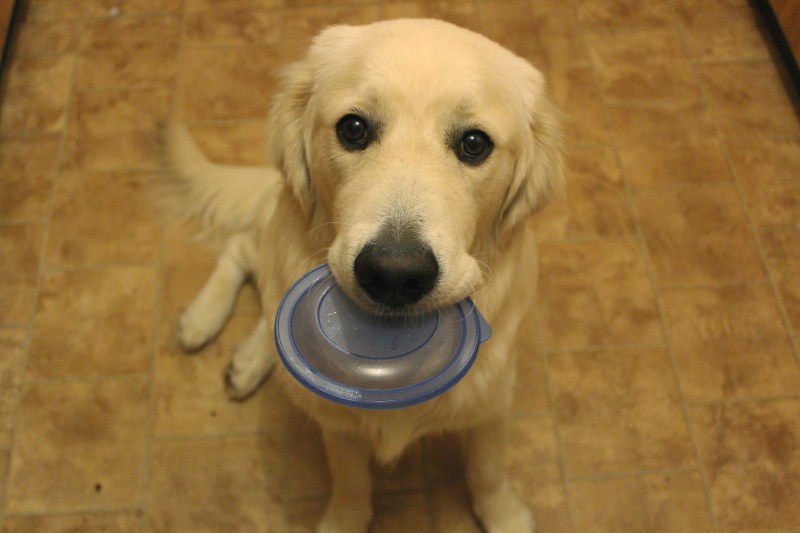
By ending with this test, you end with something positive and associate yourself with food in the puppies mind! If you do stop the testing at any stage as you think you have enough information on the individual puppy, try not to end it on a more 'negative' test. With this test you want to bring along a clear tupperware type lid, or a very low lying container that the pup will still be able to see through - but make sure it is completely clear so that the pup can see right through it. The idea is to put a hunk of food underneath the lid. Give the pup several pieces of food before very obviously putting a piece on the floor, then putting the lid on top. Then let the puppy do what it wants. This tests persistence and intelligence.

Great ----- Paws and licks at lid, tries to flip it, if gets food is excellent 3 points
Good ----- Briefly paws or mouths at the lid but gives up quickly 2 points
OK ------- Understands food is underneath but doesn't know what to do 1 points
Poor ------ Not interested at all 0 points 

Scoring

As you may not do every test with every dog, what I do is add up the points for the tests you have done for each dog, and then divide by the number of tests you did do, so that you get that puppies average score across the tests.

0 - 0.99 This is definitely not a puppy you want to try training as an assistance/service dog. Even as a pet it would take a lot of work to make it a happy functioning member of your household.

1 - 1.99 This puppy has significant potential and would likely make a good pet. It is probably quite submissive in nature, and would need some work to bring it out of its shell. If its average is in the high 1s, then it may be ok as an assistance dog if you were not planning on doing a great deal of public access work with it - and if it did well on the retrieve and tug type tests. A puppy in the high 1s would make a good therapy dog too.

 2 - 3 This is your target range for the type of puppy you want to train as an assistance/service dog. I would aim for as high as possible, but you also want to make sure that the pup scores highly on the tests that predict trainability as an assistance dog. These dogs would also make a good therapy dog.

To give you an idea, my Knightley scored a 2.7 on his test, and Apollo scored 2.8. Both dogs did/are going very well as ADs, although Apollo is so smart he gets into all sorts of very creative mischief. There were anothers in both Knightley's and Apollo's litters that got somewhere around a 2.5, and indeed in Apollo's litter every single puppy could have become assistance dogs.... they were such sociable and cheerful pups. Knightley's litter tended to score lower. In any litter you test there will likely be a few standouts. However, in the first litter I tested, none tested over 2, and one was below 1. In a case like that you just have to keep searching for the right dog. I would recommend not picking a dog that gets below a 2.0, but that is my personal opinion on the matter.

Summary of what to take

These are just all the bits and pieces I listed in the temperament test:
  • Towel with yarn attached to one corner
  • Two empty soda cans
  • Umbrella
  • Meat or puppy treats
  • A clicker or something else to make a high pitched short sharp noise
  • A squeaky toy
  • A toy for tug
  • Some pieces of paper to roll up to make paper balls and/or puppy sized ball
  • Clear plastic lid/flat container

Keeping track

Knightley after we had chosen him. He was so very tiny!
You are going to want to keep some record of how the pups did, especially if it's a big litter! I didn't bother to start recording unless the pups did well on the first couple of tests, because if they were getting zeros and ones on those first tests they definitely wouldn't be doing well on the later ones. Try to get your assistant to do the keeping track as otherwise it's a lot to do!!

By the time I had tested the seven boys in Knightley's litter my head was spinning.... but Knightley was the last one, and it was clear from the outset that Knightley was going to be the puppy for us, without having to add up scores or anything. This was the same with Apollo, he was the clear standout of the boys, although there was a girl who was even more confident and trainable. I had never tested any girls before, and did for the breeder who had been asked to supply a suitable girl for a family with an autistic child. The one I recommended was a real darling.

Final points to consider
  • Start with the right breeder, look at health clearances, try to view the sire and dam, make sure the puppies are well socialised from a young age as that will make a huge difference throughout their whole life. The more effort the breeder puts into those puppies, the less work you will have to do
  • Try to find lines which have had dogs as assistance/hearing/guide/therapy dogs, or at least have participated in obedience
  • Don't let your heart decide which puppy to go for, it may well mean rehoming when it grows up to be an unsuitable dog. There is no such thing as 'close enough' when choosing a potential AD or even a family pet
  • While temperament testing is a very valuable tool for choosing a puppy, remember you are primarily trying to weed out the puppies that are not suitable. After then it is your choice
  • Even though a temperament test means you start out with the best puppy possible, it is no guarantee that it will make it as an assistance dog. Dogs go through two main personality changes throughout their lives, so you can never be sure how a puppy will turn out. Testing just makes sure you start with the best source material possible.
If you have any questions, feel free to comment or contact me on my Facebook page https://www.facebook.com/DownunderAssistanceDog

Tuesday, April 24, 2012

The Knightley effect

This blog post has been written for the 7th Assistance Dog Blog Carnival! Please visit this page to access the rest of the Carnival and read more blog posts about the effect of assistance dogs on those people around them.

My husband and I brought home Knightley as a fluffy and very inquisitive Golden Retriever bundle at the age of 8 weeks in September last year, with the express aim of training him to be my assistance dog. I'd scoured most of the eastern half of Australia looking for a suitable litter, and I rejected 10 other male puppies before finally finding our Knightley, the last puppy to be temperament tested in a second litter. While he's only 9 months old now, he has already had a massive effect upon my life and indeed, my health; well before I thought he would.

As for a little background, I've been sick for nearly four years, the first year of which was pretty hellish as no one had any idea what was going on and I spent months in hospital. My specialist still doesn't quite know what I have - at first it was thought I likely had Lupus, but now he thinks I could have an 'auto-inflammatory' disease, which is similar to autoimmune, but much much rarer, and hard to diagnose and treat. I have mobility problems that vary in severity from day to day. When it became fairly obvious that I wasn't getting better in a hurry, I started looking for ways to make my life easier. I had trained my previous dog to a reasonable level, so I consumed vast quantities of literature on assistance dog training, clicker training and just training in general before realising training my own dog was indeed feasible.  I did research the option of seeking a dog from a training program, but for various reasons discounted it.

The effect of Knightley in those first couple of weeks in September last year was to cause me to almost rethink what I had done! Unfortunately, at first it was not exactly a positive effect. Previous to Knightley's arrival, if I felt too sick I would just stay in bed most of the day. However, an 8 week old puppy needs a lot of attention, and while I could manage a day or two like that... after a couple of weeks looking after a baby puppy I was just about falling asleep standing up and having to take a lot of medication to make it through every day. Raising a baby puppy is meant to be hard for people who are well, but for me, it was completely earth shatteringly exhausting. However, as I was so very tired, I didn't really notice that Knightley was effecting another change in me. When you have the luxury of lying around in bed feeling sick, that is what you do. With Knightley's arrival I gained structure. I simply *had* to get up and feed him, no matter how I felt. Then since I was already up, I had to play with him, I had to do that early training. I knew what was at stake in getting the right start for early puppy raising, so pushed myself despite my utter exhaustion and sickness.

Slowly Knightley's needs became less: the feedings went from four to three times a day and I didn't have to take him outside as often. As the exhaustion started slowly receding, I started realising what an effect he had already had on my life. Three or four weeks in he made me laugh and smile, stroking him distracted me from pain, the warmth of his little body eased cramps, and he gave me a reason to get up every day, no matter how awful I felt. We were doing a lot of training, just basic stuff that would one day be the basis for his assistance work for me. It was wonderful seeing him soak it all up, knowing that if everything worked out, he would truly be able to help me one day.

Things got better and better. His effect was felt in every facet of my life. Our training sessions gave me a real high when we worked well, and after he got all his shots, we took slow meandering walks together. He gave me a reason to get outside, whereas without him I would have just continued my pattern of not having been outside since I had got sick. I loved seeing his joy in discovering the world, and simply seeing him so happy always had a positive effect on my mood. The fact that I was his trainer, and would be his main trainer throughout all his learning, gave me a lot of inspiration to get going each day and get training. With every breakthrough we made, I got back self respect and self confidence that I had lost with the dramatic change in my life.

Around the time we got Knightley I started volunteering regularly at an arts organisation. I believe that if not for the structure having Knightley gave me, and the mental application I needed for his training, I would not have made a success of my volunteering like I did - especially somewhere where I actually had to use my brain. Having Knightley in my life had really helped prepare me for the workplace, and he wasn't even a working dog yet!

As we embarked on our training journey, writing my blog and participating in several forums and groups introduced me to an expansive network of dog owners and trainers. It has been great to share knowledge and learn new techniques from the many talented trainers out there in internet land. My blog has also got me writing again, which I used to enjoy a lot - both creative writing and nonfiction. The writing practice too has been good for going back to the workplace as I now do a lot of writing at the arts organisation. While actually owning and training Knightley has has its direct effect, having him around has meant refreshing other indirectly related skills that I haven't used for a while.

Anyway, about four weeks ago I decided the time had come to start some concentrated work on training the first steps of a formal assistance retrieve. Amazingly, within only five days, Knightley was able to pick up all sorts of objects on cue for me. I was absolutely thrilled, completely over the moon, because from that moment started the part of our journey in which Knightley starts truly affecting my life as a working dog - well before I was expecting it too. That won't just have an effect upon me, but also my husband and family as I get more and more independence.  Knowing Knightley is with me already gives my husband peace of mind and he worries less. I too feel much more confident when Knightley is with me, and I have only begun to train him to do the assistance tasks I intend for him to do. Assuming we become a successful assistance dog team, we will be unstoppable!

Now at 9 months old, Knightley goes into a few shops briefly with the permission of shop owners, and has been to a couple of loud busy events for further socialisation and some early public access training. He's not afraid of anything, is very happy to be out in public with people around, and is a cheerful, intelligent teenager growing up very quickly. I am thrilled with the choice I made in selecting him last September, as so far things are looking good. Aside from all the things Knightley does to make my life better, and the help he is beginning to give me, his sheer presence seems to make me healthier. I have not been admitted to hospital once since I got Knightley, due no doubt to my more active, structured and generally happier lifestyle. That is a huge benefit.

'The Knightley effect' is something I am incredibly grateful for, and I look forward to exploring what our future together may be.

Sunday, April 8, 2012

Wonderful public training, retrieving awkward objects, hubby back!

8 months 1 week 4 days old

Firstly, for those who missed it, I have a brand new Facebook page, at https://www.facebook.com/DownunderAssistanceDog. Do go ahead and join the page to get my updates about what Knightley and I are up to on a day to day basis, especially when I don't have the energy for a big post here. Also, if you ever want to contact me for any reason, it's a great way to do it.

I'm trying out a new 'thing' on my blog... bolding important phrases and words, so that you can scan an entry and see what is important, what has happened, and get the training messages quickly. Gimme a yell if you hate it!

The last couple of days have been pretty full on for both me and Knightley! Hubby came home from his 3.5 week trip to England on Easter Friday, and Knightley went to the airport with us having got permission to take him inside. It was his first time to the airport, and was his first time for several other things. He'd never been on a lift before (that went REALLY well! My dad and I repeatedly told him what a wonderful dog he was while we were in there), he'd never been on super polished floors and he was great with those, he'd certainly never seen moving baggage and that gave him pause.... but he was fascinated, not scared! I think he wanted to jump onto the baggage carousel too. He'd never heard loud announcements, and his head whipped around at first when the first one came over the PA system, looking for the source of the sound. Which obviously he couldn't find..... With strange noises and dogs, it is best to just act as if the noise is completely normal and then your dog will accept it as normal too. If you go "oh poor dog, I know, you just got a big fright, are you ok??", then your dog is likely to start getting an issue. Just act as if the noise is normal and your dog will believe it is. Once Knightley saw that I believed the announcements were no threat, he started more or less ignoring them. My husbands plane was late, but Knightley was pretty good (not ideal, shifted around a bit too much) and just rested in a down by my feet. All the work with down stays and relax has been worth it! Once again I felt like a bit of a tourist attraction, with soooo many people looking at Knightley. I can see that when Knightley is fully trained and with me all the time I will get a lot of attention from him. He gets a lot of comments about how beautiful he is, and I would have to agree. :)

Knightley was very happy to see hubby, but wasn't completely unprofessional in his welcome. We did have a bit of a slip up.... everyone was clustered around getting their bags and hubby got his smaller one and threw it towards us. It landed with quite a bang and obviously shocked Knightley quite a bit.... to the point he let out a small rather surprised bark! I was amazed... he hasn't barked before in public like that. So I told him to 'leave it!', and immediately turned around and we walked away from everyone. So that blotted his perfect record. As we were leaving I stopped at the only patch of grass outside and gave him his pee cue, and it worked immediately. What a good dog! A family was right beside the grass and saw me with Knightley, and was completely amazed. "Oh wow.... how did you do that....??! I wish my dog did that!" the mother said. I just responded that it was part of his training and was indeed very useful.

Learning to pick up my sunnies (sunglasses) where I want him to.
 I don't want him to pick them up on the lenses and leave slobber
so I am spending some time teaching him where I want him to put
his mouth. He seems happy enough to play along! When I
compare his behaviour to how he first was when I started retrieve
training there is a *huge* difference. There is almost no comparison.
He's such a good good boy.
That night after hubby came home he went to bed rather early, so we did a bunch of retrieve training with some semi delicate objects. We practiced getting Knightley to pick things up in certain places on the object. For instance, I don't want him to pick my sunnies (sunglasses) up by their lenses.... for while they are not expensive sunnies, I don't want to be seeing through drool when I come to pick them up! So I want him to learn to pick them up on the long arm thingo. So I got him to hold them first maybe 6-7 times, in the place I wanted him to pick them up. Then I started lowering them towards the floor. I would very deliberately offer the part I wanted him to hold, so that he never took the wrong part.

Retrieving a lid, which he has got a lot better at. He struggled
with anything flat at first, but now he seems to be able to
manage most of the time. He will hold it for a good long time
until I am ready to take it, and will hold it with me until I tell him
'thank you!' and then finally, he will let go. It really does come
quite naturally to him. We are slowly starting to very occasionally
do a retrieve without a treat reward, although I will do something
else instead, usually play with a toy or just make a huge fuss of
him.

However, if he did (he has on other objects), I would just wait it out until he released the object and not reward him for it, then give the retrieve cue again ('get it!') with my hand over everything but where I want him to hold. I'd do a couple of short holds, not even letting go, offering the object, then 'thank you!' and he releases, then treating him. I would slowly reduce what my hand covers until he is still holding the right place despite being offered the whole object. Then I'd start letting him get some good long holds by himself, then start  lowering the object towards the floor again before each hold until it was on the floor but I had one hand on it. If at any time he wouldn't reach and hold it on cue, then I would go backwards a step or two and make it easier for him. This is one of the keys of dog training!! Don't be afraid to go back a couple of steps when things aren't going quite right.... or even right back to basics!

Then I put the sunnies on a flat surface at his chest height, all folded up except for one arm open, and asked him to get them. He did, then swung around and gave them to me. Very nice. We did that several times, and then I slowly opened out the sunnies, only paying for retrieves where he picked it up via the arm. Then I put it on another flat surface, close to the floor, with the arms open, and we did a couple more retrieves... and then the floor. Next time I will work on having him things up that I drop before the session... which is our problem at the moment. He will pick things up after I nudge them a bit with my toe to show him what I want picking up... but it takes a little while, and a fair bit of encouragement.

The last several days I've been at the National Folk Festival, with stacks of venues with all sorts of amazing performers from all over the world, awesome food, all sorts of stalls selling clothes, jewelry and all sorts, and lots of lovely food. There's one more day to go and then it's time to recover! I've spent most of my time in my wheelchair getting pushed this year, as my health took a little dip pre-Festival (see post about coming back from shops with Knightley). However, I got permission to take Knightley for public access training and socialisation, so he's gone with me for a couple of hours on one day and a few on another, and while I've had Knightley with me I've walked with my crutch slowly. He has been a VERY good boy!! He has experienced lots more firsts, like at the airport, such as applause, live music, walking beside me in a wheelchair (wasn't for long), lying still for events (needs practice) and having a grass floored venue that must be treated as a normal floor (if you're a regular reader you know that Knightley is a massive grass fan!! It was hard....).

What a fantastic learning experience it has been. I have really seen what Knightley and I need to work on in the coming months. Lots of zen, zen, zen, zen, until it is default and matter of fact. There was quite a bit of food on the ground, and Knightley was good at the beginning of the Festival, but then once or twice ate something from the ground... which is a *huge* no no (there was so much though!). That rather spelt doom. He obeyed me if I told me to 'leave it'... but there was so much stuff on the ground that I couldn't keep saying it continuously, and unfortunately it being the beginning of autumn here, there were leaves on the ground too which *looked* like food, so he wanted to check out every little leaf too. So default food on ground zen is something we need to work on badly. If he hadn't got himself that one or two pieces of food originally then I think we would have been ok, but after that every leaf was a potential snack, sigh. Anyway, lots of work to do!

I can't decide whether to take him back for the last day or not. Every day is another learning experience, and he isn't getting too tired because he is dozing a bit during some of the performances - especially the ones in the dark venues. Also, the last day is a lot quieter than the others. However, I don't want to burn him out as these are some big experiences for a young dog. Either way he is going to have a good long break from any public socialisation and training. Lots of walks and dog park visits for the foreseeable future I think.

Thursday, April 5, 2012

Good boy Knightley!!! What a dog!

8 months 1 week 1 day old

So, I went up to the shops this morning (I live very close to my local shops) with Knightley, to get a prescription filled and do some socialisation training. However, I pretty seriously overestimated my energy reserves, because on the way out of the shops after I'd done what I needed to do, the efforts of the last couple of days caught up with me. I started having some serious trouble just putting one step in front of each other and my body was cramping up and in serious pain. I had hooked the foam handle to his training vest before we left, not to use it but just so Knightley could get used to its presence. But when I started to go into exhaustive collapse, I needed Knightley to help get me home. Someone came up to me just outside the shops and asked if I needed help - obviously I looked pretty bad - but I said my dog would help me get home. Unfortunately it got harder the further I went. The great thing is, he did help me. I used the handle and he gave me a little pull the whole way home. He was slow, and very patient as I was stopping really often. Whenever I stopped he leant against my leg and looked up at me. He really knew what was going on. I think if he hadn't been with me I could have had a bit of a panic attack which happens occasionally in situations like that where I feel utterly helpless. When we finally got home I gave him a big hug and told him thank you like a hundred times. He just panted gently, looked up into my eyes and wagged slowly.

What a good dog!!!!! I can't use Knightley to pull me much at all until he is at least 18 months old and he has stopped growing, otherwise I could risk damaging his joints. But when I am desperate for a bit of help, he's there for me. He was wonderfully behaved inside the shops, and we did a good bit of backing up in real world situations, which went really well too. I am just feeling so lucky to have him in my life today, and he gave me a glimpse of what is to come in 8-9 months.

We had a fantastic retrieve session last night as well. He is making great progress on picking up things like lids straight from the ground, which takes some precision and practice as it's quite tricky. I just have to stop him pawing them, as he does that occasionally to try to get them in a better position to pick them up. I am really proud of what he has achieved.

My legs are still absolutely killing me, so I think I'm going to have a rest now.

Saturday, March 31, 2012

Fantastic retrieve training, paw targeting and my favourite new halter

8 months 3 days old


Knightley holding his dumbell nicely. He can
hold things for 15-20 seconds easily on cue,
and when we are on a walk he will happily hold
a stick for 5 or even 10 minutes. He's definitely
a holdy dog.
So, I am happy to report that Knightley is still doing just awesomely with his retrieve training. I am getting good solid long holds, and we are working on him picking up all sorts of objects for me. He has problems picking up things like plastic lids which are too flat for him to get an easy purchase on. Maybe he needs to use the technique they teach for dogs to pick up credit cards with using their tongue to lift it a bit. Maybe I'll try clicking for seeing tongue contact tomorrow (wait until I see his tongue contact the plastic, then I click/treat immediately before he has even picked it up, so that he learns to use his tongue with certain objects). Either way, he often can't get it up, and starts pawing it frustratedly. It sometimes happens with pieces of paper too, leaving the paper worse for wear!! With everything else though, he is doing really well. His holds are in the correct place, just behind the two canines, as you can sort of see in the second dumbell photo. Dumbells are good practice for picking things up, because they kind of force him to pick it up in the middle (good practice for balancing awkward items), and are comfortable for him to hold because they are purposely made for this, and fit nicely behind his canines.

Showing the correct hold position, directly behind the pair of
canines, which is a good secure position to hold something,
and is comfortable for the dog.
It's important that I don't do too much practice with the dumbell. People that were training for obedience and not assistance work would just use the dumbell and nothing else, but in my case it's real world items I want Knightley to pick up. I don't want to do obedience or dogsports, I want him to make my life a bit easier. So we do gloves, spoons, pens and pencils, plastic lids and containers, pieces of paper, letters, his leash (I will train that to a specific cue) and really anything I can think of. He is doing very well and I am very happy and proud of him. It is amazing how fast he has picked it up since I started concentrating on it. It does show the temperament testing I did on him did seem to get it right!

The Infin8 halter from Black Dog. The black part with the two
D rings is where your leash clips onto. You can clip the two
D rings together, or undo the clip to take the collar off very
easily. The thick red part of the halter is the other side of the
adjustable collar that goes around the front of the dogs neck.
The thin red part is the adjustable strip that you wrap under
your dogs muzzle, then over it, then back under it and clip it
to the clip you see in the bottom of the photo. It makes a figure
of 8 when you view your dogs head from below. 
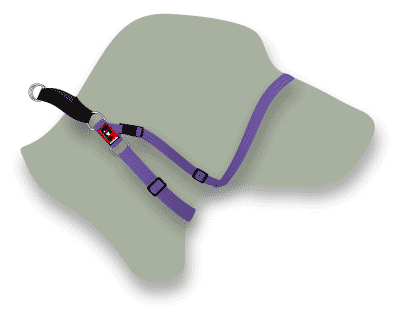
 I am very happy with the new Infin8 halter I got for Knightley. It is my firm favourite out of the Gentle Leader (a rather heavy handed, overly firm halter) and the Comfort Trainer (better, but still bothered Knightley quite a lot). For those of you who have tried halters and think your dog just can't tolerate them, take a peak at Black Dog. They are an Australian company who ships overseas, make a bunch of fantastic quality dog gear, aimed at dogsport people, and I am truly impressed with their Infin8 halter. It is different to any halter I have ever seen - really it's a mixture of a collar and a halter, and it allows a transition back to a collar better than any halter I've seen before. It is a clever design too, when your leash tightens, the collar tightens (it is a martingale collar), and the figure of 8 halter also tightens (also almost a martingale.... one side of the halter is on a running O ring). As soon as the tension is released, the nose band becomes quite lose, as does of course the collar part. The leash attaches to the collar.

Knightley with the Infin8 halter on. I got the red colour
because dogs see red very badly. If they had sold a tan
colour I would have got that, but the red has been fine,
actually. Visual disturbance is one of the reasons
why dogs don't like halters.
When your dog has been wearing the halter for a while you can start to loosen the long muzzle strap until it is extremely loose, and the dog is reacting almost entirely to the collar pressure. It doesn't matter at all if the looseness causes the noseband part to come off as the dog has a secure collar on as part of the halter. When
the dog is used to functioning without the noseband doing anything much, then it's time to slowly go back to your collar. This is partly why I think this halter is so superior - it actually helps your dog learn to walk on a collar, as well as give good head control.

Knightley with only the collar part of the Infin8 halter done up.
The part that goes around his muzzle is shown laid out with the
clip at the end. You can see the martingale D rings at Knightley's
neck where you clip the collar to. These things are what makes
this halter so different from others I have seen and used.
It's actually quite impressive how much more Knightley likes this halter than the other two. From the beginning, there was very very little pawing at it. With the GL and the CT, if I took the leash off him and left him alone he would begin pawing at the noseband until he got it off. With the Infin8 he just completely leaves it alone. So, I will continue to use it until Knightley is not pulling at all around children, other dogs and birds, and then I will slowly loosen the noseband until it may as well not be there. Then I think I will transfer him to a martingale collar from Black Dog. Why, you may ask? Well, firstly I *love* the quality of the halter, and they have lovely martingales too. But if I get a red martingale, it will nearly be identical to the halter, just minus the long wrap around bit. So it could well evoke those no pull memories. I like the safety of martingales too. When they first came out, people used them as a sort of more humane choke collar.... using them to leash pop, but doing less damage to the dogs throat and trachea. These days they are basically seen as a collar dogs can't get out of, even if they try to back out, because they tighten if the dog puts pressure on the leash. However, unlike a choke chain, they can only tighten so far, and they are made of comfortable nylon. The martingale that is part of the Infin8 has great shiny black nylon (see first photo) which means as soon as the dog releases the tension, the collar and halter are instantly loose, and much looser than a normal flat collar. It is great feedback for the dog. So, that's the plan.

The other thing I've been doing is refreshing Knightley's paw targeting. I was quite cryptic before about training an assistance skill I don't need but that would be fun to have. What I am going to do is train him to turn on a foot light (one of those ones that has a round switch that you turn on with your foot) with his paw. We haven't been doing much paw targeting for a while, so at first it was just basic stuff, getting him to target my hand, then a plastic lid, then eventually the switch. He isn't putting any weight on it yet, which he is definitely going to have to do... and I'm not sure how to do that, so I'll have to think about that.

A little bird told me about this documentary (which I am going to watch soon) that talked about the fact that 75% of successful guide dogs are 'right pawed'.... ie like humans, dogs too often have a dominant paw. I knew Knightley had one but couldn't remember which one it was until I did a bit of testing and observations.... and it is indeed the right. I guess this is a good thing, although assistance/service dogs need quite different skills to a guide dog. It's interesting that dogs have a dominant paw though. I always found it hard to get Knightley to paw things with his other foreleg, so I had wondered, but I thought it could have been due to my training just getting him stuck in a rut!

Hubby back in 6 days! Knightley is going to be happy and unhappy all at once..... he's going to lose his sleeping platform lol.....!

Thursday, March 29, 2012

Knightley is officially useful! His first working retrieve!

8 months 1 day old

Today, well ahead of schedule, Knightley did his first real 'work' for me!! After the previous two days of amazing success with our retrieve sessions, today we had two more training sessions, again concentrating on retrieve. The first one was working on bring items much further away back to me nicely - in the end we managed about three metres (10 feet), which I was thrilled at. The second session I concentrated on getting him to hold and do short retrieves on as many different items as I thought he could comfortably hold (I'll work on tricky ones later). We put a fair bit of time into getting him to learn how to pick up spoons off the floor. They are obviously quite tricky to pick up, and dogs don't tend to like cold metal, so it's important that they get practice sooner rather than later with it, or they can get a bit of a doggy phobia about picking it up.

Then about half an hour ago when we were about to go to bed, I dropped a small plastic container. I could have just sucked it up and reached down for it, but if I do that more than a couple of times a day I pay for it the next day, or I could have got my reach stick... but Knightley was there.... so I thought I'd give it a go. It was a different situation as previously I had dropped things in front of his eyes so he knew what he was to pick up... but in this case he hadn't seen it drop. I called him over, and had a big chunk of 'roo jerky (a new big favourite) ready to reward him if successful. I also flipped the container over with my foot, as it was upside down and would have been very hard for Knightley to get in that position. I nudged it a couple of times with my foot and looked right at it (not at him at all), and told him "get it!". I was grinning from ear to ear as he reached down, picked it up delicately, turned around and placed it in my hand... then waited for my "thank you!" cue to tell him to release it. It all worked perfectly!! What an AWESOME puppy!!!! He enjoyed his lovely roo jerky for a job well done.

So there is lots more work to do, but we have the beginning of an assistance retrieve. Thank you Sue Ailsby!!! I have to say, her recent books with the updated Training Levels are perfect for those training their own assistance/service dogs. (Link to her main page on the link toolbar, also Training Levels tab at the top of the page, info & links from there too). Especially the retrieve. I followed it closely, and it has come up trumps. It was easier than I thought it would be too. 'Traditional' obedience trainers train retrieves in all sorts of horrible ways (forcing dogs to open their mouths by harshly pinching their ears, or by using electrical collars and shocking the dog if they don't get what they want). Some trainers don't believe that you can train a reliable retrieve by a positive reinforcement. There are many many thousands of working dogs out there with a positive trained reliable retrieve. If it wasn't reliable then they couldn't be trusted to be the helper of some very disabled people. I have no doubt, from what I have seen, that Knightley's retrieve is going to be completely solid. He really enjoys it, as there has been pleasure in every part of the teaching - just asking him to put his mouth around something has good associations.

That is what I love about operant conditioning, how the learning process itself deepens the bond you have with your dog. The time you spend training is pleasant and stimulating for the dog. When I stop my retrieve training, Knightley will grab a toy and nudge my leg with his nose almost in protest that training stopped too soon! That just doesn't happen with traditional methods. I love having a thinking dog, and I've really been enjoying the last week of training. The beginning of Level 3 was really boring, but this was awesome fun!! I will continue to work on the retrieve, but I have also started to teach Knightley another assistance skill..... although this isn't one I strictly need, but I'd be nice to have anyway! It'll be interesting training it, definitely a good challenge. I'll tell you more about it later once I have got somewhere with it, that was really just to tease you!

My husband is still away in England, he's been away for 16 days now although it doesn't really feel like that long. He's going to be home in 8 days time, and it really will be lovely to have him back. Knightley isn't going to be happy though, he's going to lose his spot on my bed!!

Wednesday, March 28, 2012

Happy 8 month birthday Knightley, a retrieve breakthrough and a new halter!

8 months old

Knightley's extremely illustrious ancestor, Ch Camrose
Cabus Christopher. This golden was an extremely popular
stud all across the "English" style golden world (Europe,
Australia, NZ). He appears more than once in Knightley's
pedigree, and looking at pictures online of Knightley's
distant relatives who also have a lot of Cabus Christopher
in them, I see so much similarity. He was considered the
'perfect' golden, and sired a LOT of litters, including one
for the breeder of Knightley's sire.
Wow, 8 months old today. I remember when he was just a fluffy little 8 week old! When we got him at exactly 8 weeks old he was 6.4kg (14 lbs) and now I am guessing he must be about 28.5kg (63 lbs), although that could be a little off as I haven't weighed him for a couple of weeks. He's still a bit short for a male golden retriever, so I'm hoping to see another growth spurt in the next couple of months. Feeding raw has definitely slowed down his growth - which is good. I wish I had done it sooner, for that reason, as well as many others. But he definitely is a fine looking dog, and I'm sure could have been a show dog if he had been chosen by a showing inclined family. He certainly comes from a long line of illustrious sires and dams, especially the famous UK stud Camrose Cabus Christopher, who features quite a bit in his pedigree (probably too much, I would have liked him less inbred!). He is developing a very masculine head, quite blocky, and for a 8 month old, has a good amount of feathering. His smooth trot is a joy to watch... I love to watch him move, especially at the dog park. With a trot that beautiful, surely his hips are going to turn out good in his 1 year old x-rays! (which will be a deciding factor as to whether he can actually work as an assistance dog or not).

We had several short training sessions today, working mostly on our retrieve, and we really had a breakthrough. He is now about to pick up objects (spoon, pencil, dumbell) from the floor several steps away, then walk over, place it in my hand then wait for the cue to release the object. We can hold objects together for 15 seconds+. I am very very happy with him! I can *definitely* see a solid assistance retrieve before he's a year old!

Training this type of retrieve is *very* different to just playing fetch. I am looking for very controlled behaviour, lifting the object right behind his canines, being controlled in how he comes over to give it to me (no boisterous running or anything), and only doing it on cue. Once he has this cue down pat with all sorts of objects including unpleasant ones like hair brushes, we'll start practicing it in public, where he will really be useful to me. I've always wanted him to be able to hand me the handle of my handbag, as I hate having to reach down for it, so I think I'll try sewing a patch on the handle, partly to mark where he is to pick it up from, partly to protect it. He won't actually have to lift up the bag itself, only the strap, and then I can lift it myself. This is similar to training him to pick up his own leash, which is another thing I will have to do (dogs have to do this in airports, for instance, when they are called through metal detectors). Once he has a lot of experience in different places with different objects, then I will start teaching new cues for different objects.... for instance picking up delicate things like credit cards usually needs a dog to use their lips and not their teeth, so needs to be completely retrained. Similarly for pieces of paper, so they don't get slobbered on. So getting a basic retrieve in place is going to be great, but it's only the first step.

I got two doggy things in the mail today. The first was my new halter, the Infin8 by Black Dog. I am very very happy with it! This is, so far, my favourite out of the Gentle Leader and the Comfort Trainer. It is very different in design to the other two, as it has a martingale collar, to which a figure of 8 thin band is attached and wraps around the muzzle of the dog. When the martingale tightens, the halter part tightens too. The idea is to start with the band tight-ish, and once your dog is really behaving nicely, you start loosening it more and more, until it's really just a collar. I am very impressed with the quality of the halter, it surpasses the other two, and Knightley is far less bothered by it. It was much harder to adjust for size, but once you've done it, then you don't have to do it again. I think it would have been easier for me if had been able to get the smaller size, but as Knightley is still growing, I opted for the larger - as he was between the two in size. It meant a lot of adjustment to get the big one to fit. Anyway, I like it a lot, and think I may have hit open a winner here.

The other thing I got was some kangaroo jerky, as jerky I had got in the past Knightley had loved - but it had been expensive pet store jerky. This was obviously a little more 'rustic', as some of it still had kangaroo fur attached!!! It was also like an eighth the price of the stuff I've bought in the pet store before. Knightley absolutely went nuts when I opened the package, and it has been a hit all day for our training. I have been hard pressed to find things to take out with me since I started Knightley on a raw diet. I would rather take raw meat, but I don't really want those sticky bloody hands outside the house, especially out in the public where I might be putting my hands on public furniture etc. This jerky, which is obviously very natural, may well fit the bill. Only problem is it's rather hard to cut up!

Anyway, the pup is breathing deeply beside me on the bed right now, sleeping soundly, and I think I might just join him.


Tuesday, March 27, 2012

Great training sessions! Retrieve basics,eye contact and resource guarding

7 months 4 weeks old

We've had some great training sessions in the last couple of days, really getting back to where we were before on our retrieve holds (and more!) before I stopped training them in order to concentrate on finishing Level 2. We've got to the point where Knightley will walk three or four steps on cue, take an object from my hand, and hold it with me for at least 10 seconds, 5 of which he is holding it by himself. I then start holding it with him again, then tell him "thank you!" and he gives it to me. The next step is to get him walking more like 4-5 steps in order to get the object, then to let go and have him walk to me to deliver it, hold it together, then tell him thank you. I have managed to get him maybe half a step towards me to give me his dumbell, but I'm going to wait until we have at least a 15 second hold (together) until I push for a couple of steps walk towards me to deliver. Today I did manage to get him to take the dumbell from a stool on cue for the first time. It was the first time he didn't just take it from my hand. So we're definitely getting there!

I'm trying not to rush this, but I'd really really love a trained assistance retrieve a bit ahead of schedule!! I have actually used Knightley to pick up things before, but in that case it is moreso his curiosity. For instance, I've dropped my keys, and I nudged them with my foot and made them 'dance' a bit to get Knightley interested as cold metal isn't hugely fun, then when he picked them up, I praised like crazy and lightly held his collar to stop him retreating to inspect his new toy, while quickly grabbing a treat from my pocket which I exchanged for the keys with again, lots of praise. The technique works to an extent, but only if I can tempt him to pick it up. It needs to be a cued behaviour - in this case, 'get it'. So, it's going pretty well.

Our eye contact, where Knightley needs to keep 15 seconds eye contact with me without me actually looking at him, is going well. We are up to 15 inside, but not outside. Focusing outside is not Knightley's strong point, especially around GEE - ARR - EEH - ESS - ESS ! (Better spell it out right now or he'll wake up as he lies beside me on the bed! That's how much it excites him! Although we are working on it). We did some eye contact work up at the local shops today. He really does find it pretty hard to focus with all those fascinating people around. I think it's a perfect place to work on this actually, but it's going to be hard to get up to 15 seconds in a very high distraction place like the local shops after 5 on a weekday.

The Infin8 halter by Black Dog. It is a martingale collar, with a
figure of 8 halter that wraps around the muzzle. You can start
with the figure of 8 part fairly tight, giving you good control,
then slowly loosen and loosen it, until really the dog is just
wearing a collar. It's a great way to transition from a halter to
a collar successfully. Unfortunately they don't have a tan
option, so as to cause less visual disturbance to Knightley,
so I went with red as dogs see red very badly.
We are working hard on our loose leash - SIGH! I wrote an email to the trainer I wanted to work with, and got a reply saying she is taking a break at the moment.... grrrr. I did talk to a guy a while back about helping me, just not sure if he was the right fit. Maybe I should just try him anyway. I think Knightley *is* learning to give to the leash pressure and fight it less in the face of high distractions. He loses his focus on me though, and if there is something like a possum around (there was one walking along the fence just now outside, Knightley was quivering like a violin string!) I simply may as well not exist and it takes some significant force on his collar to get him moving. I am trying *one* more halter as a training device.... it's one I considered before, the infin8 by Black Dog. We'll see how it goes.

I did make an interesting discovery though. When we are doing public 'assistance dog' training, Knightley automatically goes into 'assistance dog walk', which is a very measured walk, almost a plod lol. Last time we were out practicing our public manners, I tried him with only his collar, and he was actually quite good, there was barely any pulling. Far better than he is just doing loose leash. I suppose there could be a few different reasons for this, but whatever the reason, perhaps I won't actually need the halter much afterall.....

I have noticed something a little worrying in the last week or so - the development of a small amount of resource guarding. He growled at me and did a wrinkly face when I tried to take a bottle cap from him, and I was pretty shocked. He has also been very protective of the food I've been feeding him, which obviously being raw, is very high value, so isn't that surprising. I was pretty shocked about the bottle cap though. I am being very very careful to 'trade', giving good treats for whatever Knightley might have in his mouth (he is a golden retriever puppy afterall, and despite his training, he likes getting things in his mouth as much as possible!), and giving him total privacy when he is eating so he can relax with the food.

Immediately after the bottle cap incident I went and ordered the book Mine! by Jean Donaldson, which is meant to be *the* best book for resource guarding problems, so hopefully I can nip any behaviour in the bud. I've also ordered some new equipment from my custom leash/harness maker, and one of those is a leash belt, with specially made double ended leash, so I think we might do a bit of umbilical leashing to put Knightley in his place., I'm thinking some other techniques from Sue Ailsby's "Leading The Dance" wouldn't go astray either, which is a program for behaviour problems that includes operant conditioning techniques (clicker training, basically!). Follow the link to Sue's page on the link sidebar if you're interested in reading about Leading the Dance. I am not hugely surprised about the timing this has come up - 8 months is a big time of change and hormones for dogs, I was almost waiting for something to happen with my almost perfect pup! If this is all, I will be lucky!